Patience, waiting, longing… These three words perfectly capture the story of Dobrota lace. It was from these feelings, centuries ago, that the art of lace-making emerged, a skill that continues to attract attention even beyond the borders of Montenegro. That this unique Boka Bay heritage has not gone unnoticed is confirmed by the prestigious Europa Nostra award, one of the most significant recognitions in the field of cultural heritage preservation, awarded by the European Commission. The Kotor Public Cultural Institution “Museums” received the award for its project dedicated to preserving and promoting Dobrota lace.
The art of making Dobrota lace was on the verge of being forgotten. There was no organised way of passing the knowledge on, and only a handful of women were familiar with its complex technique. Five years ago, the Kotor “Museums” therefore launched workshops titled An Old Skill for a New Age, which later grew into the “Pacijenca” project. According to the institution, the free training sessions were organised in cooperation with Nada Radović, the officially recognised custodian of the Dobrota lace-making tradition, who successfully passed her knowledge on to new generations.
“We had great interest from the very first year. Over the course of five years, around 60 women completed the workshop, many of whom are still actively making lace today,” says Dušica Ivetić, director of the Kotor Public Cultural Institution “Museums”.
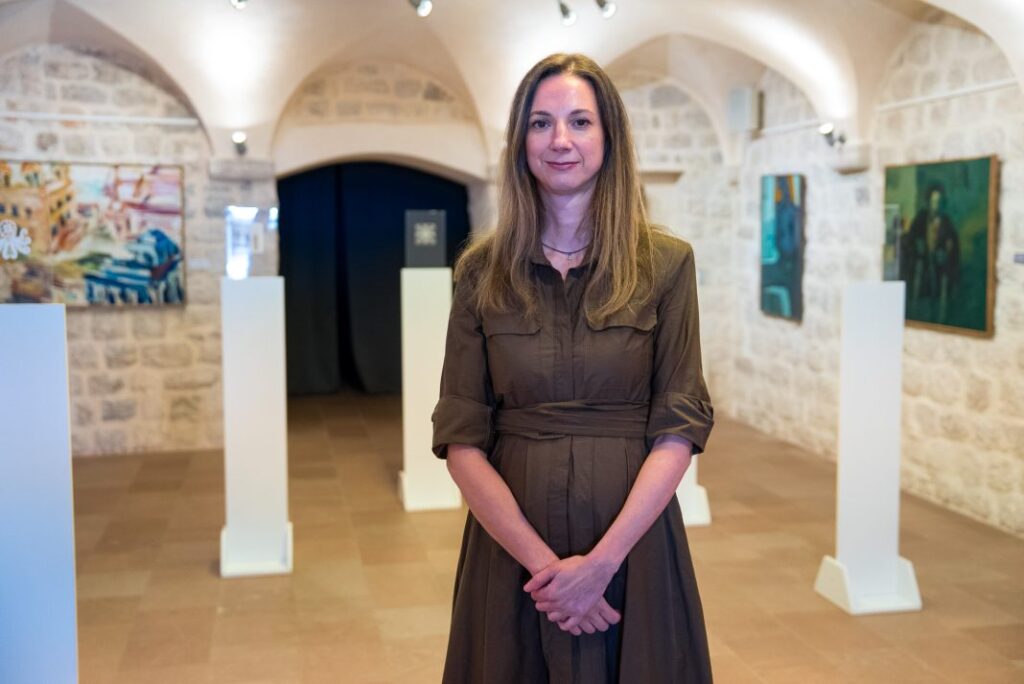
The traditional skill, Ivetić says, can also be presented in a modern way and, in this form, recognised as part of Europe’s cultural heritage.
“The entire project was conceived as a kind of performance. In public squares across the town, we present the lace in the form of a small installation, while lace-makers demonstrate how it is made. We have succeeded in connecting tradition with a contemporary way of presenting it, which has generated great interest among both tourists and residents. What is particularly important is that people have become aware of the significance of the lace and that today there is a collective awareness and sense of pride in this long-standing tradition in the town,” Ivetić emphasises.
Yet what visitors see in the squares is only a small part of the process that precedes the creation of each motif, explains Ljubica Krivokapić, a curator at the Kotor “Museums” and an instructor in Dobrota lace-making.
“Other types of embroidery are much simpler than Dobrota lace. It is made with a needle and fine thread. We start with a drawing that we create ourselves. We make the foundation on cardboard. The entire magic of the process takes place above that foundation. There are several basic stitches. Most needle-made lace also uses them, but the motifs and the way the lace is applied are what distinguish us, as is the way the tradition developed within the local community,” Krivokapić explains.

Every detail is the result of hours of painstaking work.
“It takes between four and six hours to make a single square centimetre of solid stitching. It is very delicate work, because the thread does not always do what you want it to,” says Krivokapić.
This is also why the name “Pacijenca” carries a special symbolism. Dobrota lace is not merely a skill involving a needle and thread; it is also a story about time, dedication and the values of Boka Bay.
“People very often ask whether anyone can learn it. They can, but patience is precisely the quality that is essential both to starting and to continuing along this path,” Krivokapić says.

Thanks to organised training sessions, demonstrations in town squares and international recognition, Dobrota lace is no longer merely a remnant of Boka’s distant past. The traditional lace has moved beyond the confines of museum spaces to become one of the most recognisable symbols of Kotor and Montenegro. The Kotor “Museums” say they will continue organising workshops and festivals that bring together lace-makers from Mediterranean countries, while one of their next goals is to have Dobrota lace inscribed on the UNESCO Representative List of the Intangible Cultural Heritage of Humanity.
Article and photo source: ME4EU