


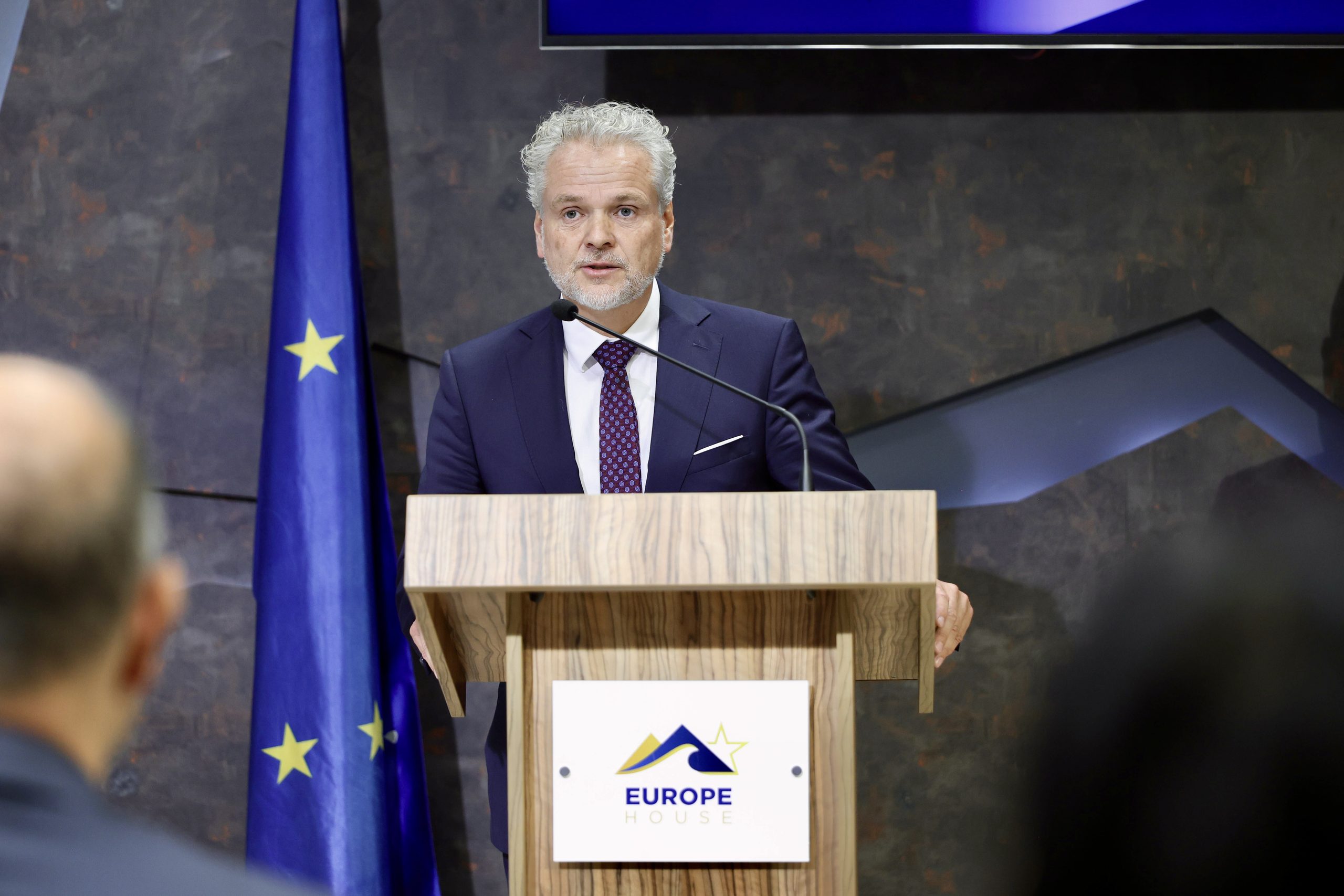
“Today is a historic day for the European Union’s enlargement policy. For the first time in 15 years, the European Commission has published an Enlargement Package recommending that a candidate country is ready to close all its remaining negotiating chapters and conclude accession negotiations. And that country is Montenegro,” said the Ambassador of the European Union to Montenegro, Johann Sattler, during the presentation of the European Commission’s 2026 Montenegro Report.
This is the report Montenegro has been waiting for and working towards for many years. It represents a major step forward on Montenegro’s European path and sends a clear message: EU membership is within reach.
“We are no longer talking about Montenegro as a country aspiring to join the European Union, but as a country preparing to become a Member State,” Sattler said.
Since November 2025, Montenegro has provisionally closed 14 negotiating chapters, bringing the total number of provisionally closed chapters to 21.
The Ambassador highlighted the contribution of all pro-European political parties, both in the Government and in opposition, which have delivered on their promises and supported the substantive reforms that have brought Montenegro to the threshold of EU membership.
He also praised Montenegrin civil society for supporting European reforms, as well as the dedication of hundreds of civil servants across Montenegro’s institutions. Without their commitment, expertise and tireless work, Montenegro would not have achieved the progress it has made on its European path.
Through this year’s Enlargement Package, the European Commission has, for the first time, presented a clear roadmap for the four most advanced candidate countries, specifying what each still needs to do to be ready for EU membership.
“For Montenegro, that roadmap is exceptionally short. The key point is this: if the remaining reforms are implemented on time, Montenegro is on track to conclude its EU accession negotiations by the end of this year and sign the Accession Treaty by June 2027,” Sattler said.


Montenegro is not the only one preparing for EU membership. The EU is also preparing for Montenegro. The Council has established an ad hoc working group on the Accession Treaty, and work on drafting the text is already underway. The Commission has also adopted a financial package, marking another important milestone.
“Montenegro is now at the very end of the road. The goal is clear and, we believe, within reach,” the Ambassador said.
However, all negotiating chapters will continue to be closely monitored to ensure that Montenegro is not only ready but remains ready to become the next EU Member State.
The Ambassador said that, in the period ahead, the focus would increasingly shift towards monitoring and verifying the fulfilment of commitments – right up to the day of accession.
According to him, this will require maintaining political stability, securing broad support across the political spectrum, fostering good relations with EU Member States and remaining resilient in the face of attempts to divide and polarise society.
“The opportunity before Montenegro is historic. The roadmap is clear. And the goal is within reach. Now is the time to stay focused, maintain momentum and bring this work to completion,” Sattler concluded.
Findings of the Annual Report
The European Commission’s Annual Report assesses two main parameters: the country’s overall level of preparedness to assume the obligations of EU membership and the progress made over the previous year. Montenegro has achieved outstanding results in both areas, reflecting the enormous amount of work accomplished.
The Report once again highlights the Montenegrin authorities’ commitment to the strategic goal of European integration. It notes that the Government has been working and delivering results in a largely stable environment, while maintaining a strong focus on the European agenda. At the same time, the Annual Report points to periodic political tensions that could have slowed progress in implementing key reforms, such as the completion of constitutional amendments and key appointments.
The Report also commends the adoption of constitutional amendments concerning the judiciary and the Central Bank. However, further constitutional amendments still need to be completed to provide for the removal of immunity for the President and members of the Government in cases involving criminal offences against official duty, as well as the introduction of integrity checks for candidates for Prime Minister and ministerial positions.

Under the Fundamentals cluster, the Annual Report notes positive developments across all areas, with a good level of preparedness and good progress in public administration reform, Chapter 23 – Judiciary and Fundamental Rights, including the fight against corruption and freedom of expression, and Chapter 24 – Justice, Freedom and Security, including the fight against organised crime.
The Report also gives a positive assessment of the appointment of the remaining judges of the Constitutional Court and members of other bodies, while noting that two members of the Judicial Council still need to be appointed.
On Chapter 24, the Report highlights full alignment with the EU’s visa policy as an important step forward.
Security and resilience are becoming increasingly important aspects of accession preparedness. To reflect this, a dedicated section on resilience, defence and security has been introduced in the Report for the first time this year. This is particularly important for Montenegro, given the recent increase in foreign interference and hybrid attacks.
Furthermore, alignment with the EU’s Common Foreign and Security Policy, including the EU’s restrictive measures, remains crucial, and the Report commends Montenegro’s full alignment in this area.
On the economic criteria, Montenegro has also achieved positive results, with improved preparedness and good progress in developing a functioning market economy and the capacity to cope with competitive pressure and market forces within the EU.
Across all negotiating chapters, the Report identifies positive developments, with a generally good level of preparedness and very good or good progress in many chapters.