


An interview with Ivana Jelić
“The desire to demonstrate that a woman can succeed on the strength of her own work, without yielding to blackmail, became my struggle. That awareness shaped me both professionally and personally. It strengthened me and greatly helped me in life.” With these words, Ivana Jelić encapsulates the essence of her professional and personal journey, which led her to one of the highest judicial institutions in Europe.
Prof. Dr Ivana Jelić is a judge and Vice-President of the European Court of Human Rights in Strasbourg, a Professor of Public International Law and a member of the Senate of the Association of Lawyers of Montenegro.
She has built a distinguished academic and international career in public international law and human rights by teaching at the University of Montenegro and undertaking advanced studies at prestigious world universities such as the University of California, Berkeley, Columbia University, the London School of Economics and Political Science, and the Free University of Berlin.
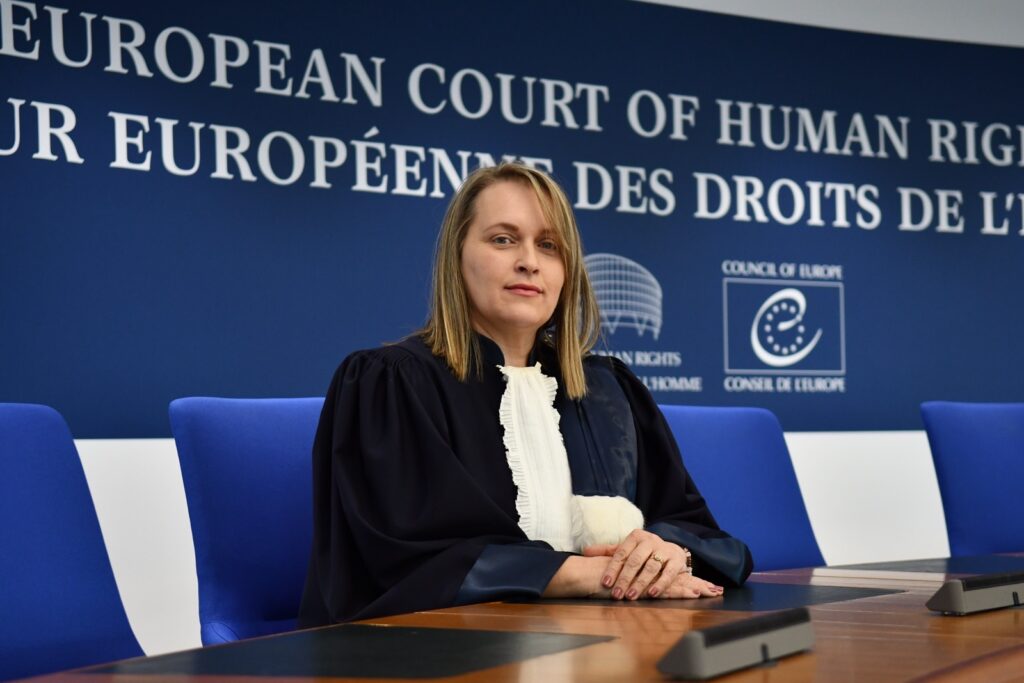
She has served as a member and Vice-Chair of significant international bodies, including the United Nations Human Rights Committee and several expert bodies of the Council of Europe, and has actively contributed to the development of European and international human rights protection standards.
She is the author of more than one hundred scholarly articles and international monographs. Even after assuming office as a judge of the European Court of Human Rights, she has remained actively engaged in academic and professional initiatives in international justice and Convention law.
“My professional path to the Court in Strasbourg was marked by hard work and a constant pursuit of excellence,” Jelić emphasises.
During the interview, she also reflected on the current state of the judicial system, which, in her view, must become fairer towards women.
Jelić stresses the need for a consistent and systematic understanding of the State’s positive obligations to protect women from violence and discrimination, in the light of Articles 2, 3 and 14 of the European Convention on Human Rights.

“Continuous and substantive training of judges, prosecutors and other judicial actors on gender-based violence, implicit bias and international protection standards is essential. Equally important is the establishment of clear accountability mechanisms when institutions fail to respond in a timely or adequate manner,” Jelić states. She also added that from a personal perspective, she believes that the law has transformative potential, but only if we apply it with an awareness of the social context in which it operates.
Systemic injustice towards women, Jelić notes, remains present in the spheres of gender-based violence, workplace mobbing, protection in the context of reproductive rights, structural economic inequalities and limited access to decision-making positions.
“It is particularly important to emphasise that the contemporary understanding of human rights entails a country’s positive obligations — that is, not merely refraining from violating rights, but also actively protecting individuals from discrimination and violence,” Jelić underlines.
Jelić also addressed the need for further affirmation of expertise and authority among young women in Montenegrin society.
Doubt is an integral part of any serious intellectual and professional work; however, it should always lead to further reflection and improvement.
“I have never doubted myself or my determination to persevere on the path towards new knowledge. Yet there were moments of challenge when I asked myself whether my faith was strong enough to withstand the burden of injustice and sacrifice for something uncertain — namely, success,” Jelić recalls.
“To girls who wish to pursue a career in law, I would advise them to believe in themselves, to invest in continuous professional development, and not to accept an inferior status or the limitations imposed on them by others. Desire alone is not sufficient for success. The same can be said of talent. Without commitment and dedicated hard work, there can be no great achievements,” Jelić concluded.